Graduate Thesis Collaboration
2025
Expressions of Alamelu
An exhibition that blends Kuchipudi, a traditional Indian dance, with AI visuals to make cultural performance more accessible and educational for new audiences.

Overview
Bringing Kuchipudi to new audiences
Expressions of Alamelu is an exhibition design project that uses new technology to improve cultural performances. It grew from a desire to merge our individual thesis projects into one collaborative experience, built around the story of Alamelumanga, which carries all the core elements of Kuchipudi, an Indian classical dance form.
I worked as designer and performer with Gabe, Sofia, Kathy and Cameron, using TouchDesigner, Figma and projection mapping. We blended Kuchipudi with AI visuals to create an engaging, educational and culturally authentic experience for new audiences, and we had three weeks to do it.
The exhibition ran for one day with three performances for 75+ people from the design community, and our paper was approved for the AHFE Conference in July 2025.

Challenge
Outsiders at a cultural performance
Project statement
We’re creating an interactive multimedia show using AI technology, presented in performance spaces, to introduce non-Indian audiences to Kuchipudi, a traditional Indian dance. Our goal is to help them understand the cultural context of the performance.

Timeline
Pain points we heard
Feeling like an outsider
No context for the performance is provided
Long duration of the performance
Technology distraction
After pulling insights from our user research, we wrote a challenge statement that defined our who, what and why. It let us start on the moodboard, flyers, and technical implementation for the performance space.
Research
How might we design a performance that engages the senses and educates cultural enthusiasts through storytelling, incorporating technology that enhances the performance and increases accessibility to the culture?
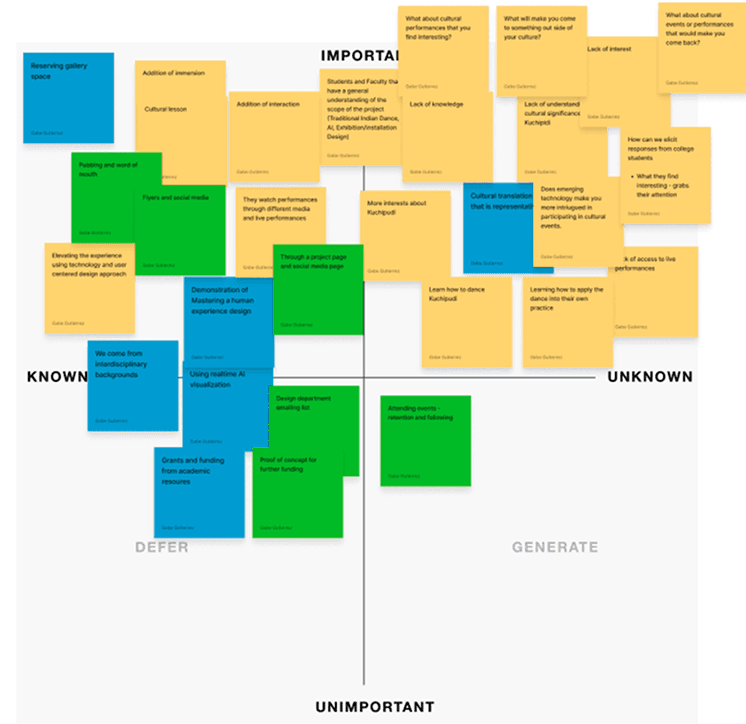
Assumptions mapping
Conducting an assumptions mapping exercise helped us identify knowledge gaps and refine our user research focus. Through surveys (25+ participants) and interviews (10+ users), we gathered insights to define our target audience.
Audience perspective on tech in cultural performances
“I don’t really know but I guess the idea behind this form of mixing cultural performance and technology is interesting. Now I would want to see that.”
“Being able to add to the storytelling experience through use of imagery, sights, motions.”
Target user persona: Steve
Steve is a cultural enthusiast who loves to learn about various cultures by attending traditional performances.

Ideation
Moodboard to projection plan

Gallery space setup inspiration

Projection mapping planning

Prompt generation to live performance AI visuals

Graphic Design Poster Development
Exhibition
The Cultural Performance
What the audience said
1 day exhibition, 3 performances, 75+ design community audience. Post-performance surveys showed high satisfaction with the AI visuals, noting they made the performance accessible and educational. Participants appreciated the blend of tradition and modernity, and many expressed newfound interest in Kuchipudi.
Cultural impact: helped demystify a traditional Indian art form for non-Indian audiences and reinforced the importance of preserving cultural authenticity while innovating.
Recognition: praised for demonstrating how design and technology can enrich cultural storytelling. Approved paper for the AHFE Conference, July 2025.
Lessons
Results and takeaways

Challenge: time and hurdles
We managed this project independently while juggling coursework and other commitments, completing it in just three weeks. With no budget, we relied on support from friends, mentors, and the Design department for space and resources.
How we overcame it: communication
Resourcefulness, strong communication, and careful planning helped us navigate challenges. By sticking to a structured design process, we managed constraints and learned the value of teamwork and adaptability in real-world projects.
Key takeaways
Collaborative design: integrating diverse expertise, from cultural knowledge to technological skills, made the project succeed.
Empathy and accessibility: human-centered design ensured technology served as a bridge, not a barrier, to understanding.
Resourcefulness: impactful designs can emerge with limited time and resources, given clear goals and strong communication.


